
Our Approach to Impact Measurement and Management
At DevelopTalent, we believe that creating meaningful and sustainable impact requires more than delivering programmes and projects. It requires us to understand, measure and actively manage the difference we make.
Our approach brings together two complementary frameworks:
-
The Five Dimensions of Impact, developed through the Impact Management Project (IMP), provide a structured way of understanding and assessing the impact of our activities.
-
The Seven-Step Impact Measurement and Management Process, presented by Saïd Business School at the University of Oxford, provides a practical process for defining, measuring, assessing, reporting and improving impact.
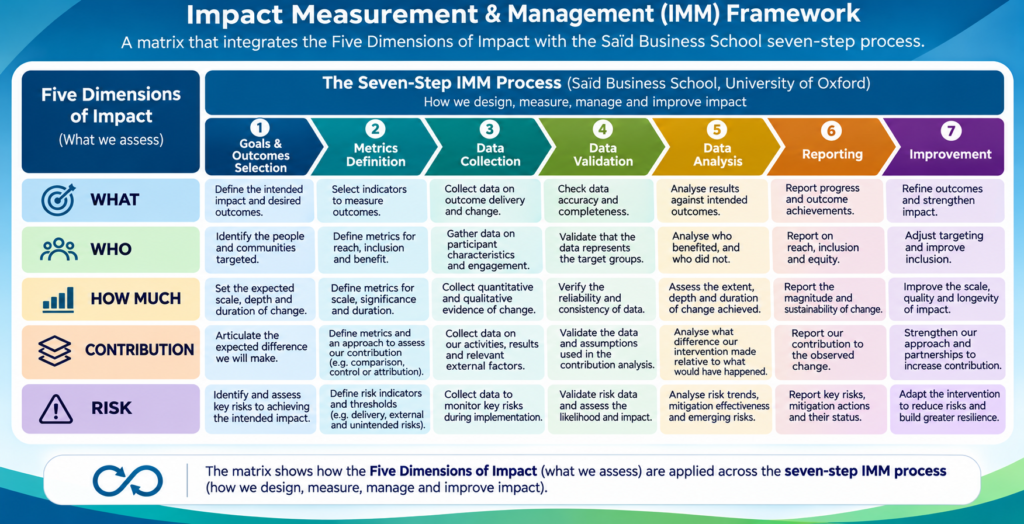
By integrating these approaches, we have developed a matrix that connects what we need to assess with the processes through which we manage impact.
The Five Dimensions: What We Assess
The Five Dimensions provide the questions we use to understand the impact of our work:
-
WHAT: What outcomes are we seeking to achieve, and how important are they to the people and communities affected?
-
WHO: Who experiences these outcomes, and what are their circumstances and needs?
-
HOW MUCH: How many people experience the change, how significant is it, and how long does it last?
-
CONTRIBUTION: What difference are our activities making compared with what would likely have happened without our intervention?
-
RISK: What factors could cause the actual impact to differ from what we expect?
Together, these dimensions help us develop a comprehensive understanding of the positive and negative effects of our activities and the value they create.
The Seven-Step Process: How We Manage Impact
The Saïd Business School process provides the practical steps through which we manage and improve impact:
-
Goals and Outcomes Selection: Define the intended impact and identify the outcomes we want to achieve.
-
Metrics Definition: Select appropriate indicators and measures to assess performance and impact.
-
Data Collection: Gather and organise the information needed to measure progress and results.
-
Data Validation: Check the quality, accuracy and reliability of the information collected.
-
Data Analysis: Analyse the evidence to understand performance, identify trends and draw meaningful conclusions.
-
Reporting: Share progress, findings and results with relevant stakeholders.
-
Improvement: Use the insights gained to strengthen our approach, address shortcomings and improve future outcomes.
Bringing the Two Frameworks Together
The matrix brings these two frameworks together. The five dimensions form one axis, identifying what we need to understand and assess. The seven management steps form the other, showing how we address each dimension throughout the impact management process.
Each intersection illustrates how a particular dimension is considered at a specific stage. For example, when defining goals, we consider the outcomes we want to achieve, who should benefit, the scale of change we seek, the contribution we expect to make and the risks that could affect success. As implementation progresses, we collect and validate evidence, analyse results, report findings and identify opportunities for improvement across all five dimensions.
This integrated approach ensures that impact measurement is not simply an exercise in collecting data or reporting results. It is an ongoing management process that informs decisions, strengthens implementation, promotes accountability and supports continuous improvement.
Our objective is to ensure that everything we do is informed by evidence, measured against meaningful outcomes and continually improved to maximise the positive impact we create.